Do Small Businesses Need a Website? What the 2026 Data Says
Do small businesses need a website? Most do, but the reason isn't the one you usually hear. It has little to do with looking modern. It has a lot to do with what a customer does in the half minute before messaging you.
Plenty of posts say yes and stop. This one checks the numbers, from BrightLocal, Clutch and a September 2026 trust survey, and says which figures are American rather than Indonesian.
The Short Answer
Yes, if strangers ever find you before they buy. Not urgently, if every customer arrives by recommendation and never checks you out. Most businesses sit in the first group, so for most owners the question of do small businesses need a website has a practical answer: yes, and a small one is fine.
What Customers Do Before They Buy
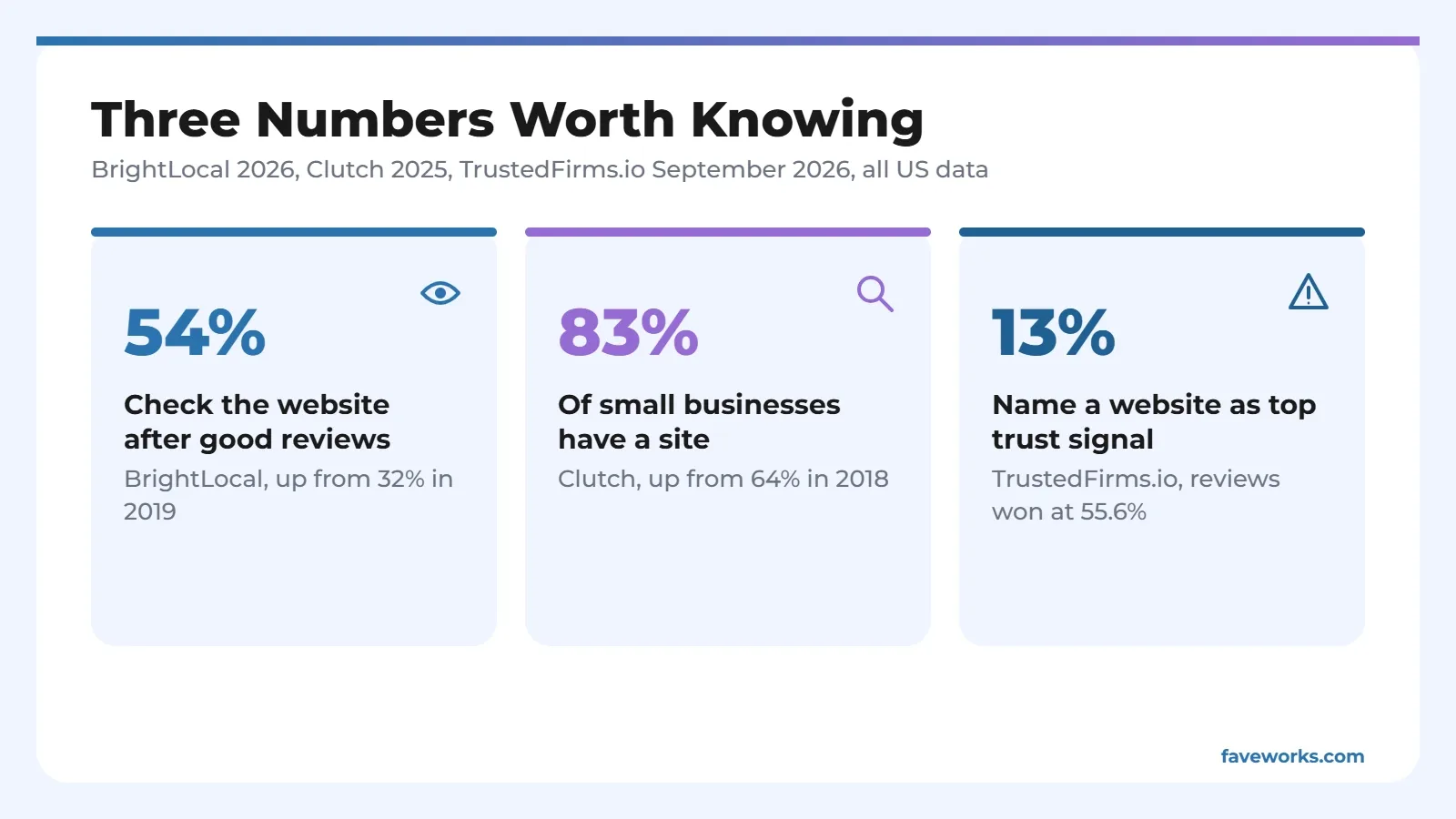
BrightLocal's 2026 survey of 1,002 US adults says 97% read online reviews for local businesses. After the good ones, 54% also open the business's website. In 2019, 32% did.
So the site is a second stop. Reviews make people curious. The website is where they confirm.

Doubt runs deeper than you'd guess. TrustedFirms.io surveyed 1,146 US adults in September 2026. 97.1% had worried that a business they found online might not be real. And 87.7% had dropped a purchase because the information was thin. People checked three places: reviews (83.6%), Google (81.6%) and the website (68%).
Same caveat as always. Americans, not Indonesians. But APJII counts 229.43 million internet users in Indonesia, 95% of them on phones, and it lists online fraud among the most common cyber incidents here. I'd guess the suspicion travels well.
How Many Small Businesses Already Have One
Clutch reported in August 2025 that 83% of small businesses in the US have a website, against 64% in 2018. Of the 17% without one, 34% said a site isn't relevant to their industry. Some of them are probably right. Many aren't.
BrightLocal's 2025 SMB marketing report lands lower. Only 40% of the small businesses it polled had a dedicated website. Facebook got 50%, Instagram 44%. Different samples, different answers. Still, plenty of owners run on social media alone.
What a Website Can't Fix
Here's the honest bit about do small businesses need a website as a question. In that same TrustedFirms.io survey, only 13% picked a professional website as the strongest trust signal. Positive reviews took 55.6%.
A website doesn't rescue a business with a bad reputation. It works alongside reviews and a Google Business Profile. Our Indonesian post on E-E-A-T explains how Google weighs trust in general.
When Social Media Alone Is Enough
There are cases. Here is a rough way to sort yours.
| Your situation | Social media alone | Add a website |
|---|---|---|
| You are testing an idea this month | Fine | Not yet |
| Every customer is a referral | Probably fine | Optional |
| New customers ask "do you have a site?" | Weak spot | Yes |
| You answer the same questions every day, about prices, hours, booking and delivery | Tiring | A single page can answer them |
| You want a spot in nearby searches | Hard | Yes |
| Your whole business lives inside one app account | Risky | Yes |
That last row matters more than people admit. An account you don't control can vanish, and so can your reach. Our Indonesian comparison of website vs Instagram for selling goes through the reach data.
A Made-Up Example
So do small businesses need a website when the whole business is one person with a toolbox? Say Budi runs an air-conditioner repair service in Surabaya (invented, though the pattern isn't). Customers find him by typing "AC service near me." No site? They get a map pin and a couple of reviews. One page? Prices, service areas, response times, a booking button.

Does the page make people trust him more? Probably a bit. Does it save Budi from replying to the same 30 questions a week? Almost certainly. For Indonesian readers, our post on local SEO covers the map side of that.
What a Small Business Site Needs
Not much.
A way to reach you
A phone number, WhatsApp button or booking form. Test it from your own phone.
Basic facts
Services, prices or ranges, hours, location. Make people ask, and a lot of them simply leave.
Proof
Real reviews, real photos, a short note on who you are. Don't invent testimonials. People notice.
Speed on a phone
Most visitors arrive on mobile. A heavy page loses them before it loads. Our English post on interaction to next paint shows how to check responsiveness.
Start Small, Without Code
If do small businesses need a website is still nagging at you, test it cheaply. You don't need a 20-page site on day one. Costs vary widely, and our breakdown of website development cost in Indonesia compares what five providers charge.
We build a tool for this at Faveworks, so treat this section as promotion. The Faveworks Landing Page Builder lets you pick a layout for your type of business, fill in your offer and publish. There are 23 layouts, a WhatsApp button, and pages that read well on phones. No coding. Try it with your own business name at the Faveworks Landing Page Builder.
FAQ
Is social media alone enough?
For a few months, maybe. After that you live by someone else's rules and reach.
Is a Google Maps listing enough?
It shows hours and reviews. It can't hold your price list or the answers you type out every day.
What does it cost?
From close to nothing for a template page to thousands of dollars for custom work.
Must I code?
No. Fill in text and photos.
Will a website bring sales on its own?
Not by itself. Price and service still do the selling.
How many pages at first?
One.
References
- BrightLocal, Local Consumer Review Survey 2026
- KRDO (Stacker), 97% of Americans have worried that a business they found online might not be real
- Business Wire, Clutch Report: No-Code Tools Fuel Website Growth Yet 17% of Small Businesses are Still Offline
- BrightLocal, SMB Marketing Report 2025
- Bisnis.com, Data APJII: Pengguna Internet di Indonesia Tembus 229,43 Juta Orang pada 2025
Tags customer trustlanding pagelocal businesssmall business websitewebsite for small business