Local Link Building for Small Businesses and How to Earn Links Nearby

Local link building is the effort to earn links from sites around your business: partners, event organizers, local media, communities, and associations. Google lists the number of sites linking to a business as one input to prominence, meaning how well known the business is.
You do not need hundreds. Ten links from sites that truly relate to your area and field often help more than a hundred random ones. And one point belongs up front: links bought to lift rankings break Google's spam policies.
Why Local Links Matter
Links help Google judge how well known a business is. Google Business Profile documentation says prominence is partly shaped by the number of websites linking to your business, alongside review count and rating.
The 2026 Whitespark survey gives a sense of the weight. The quality of inbound links to the page used by the business profile ranks 25th (score 127), and links from locally relevant domains rank 26th (score 126). That counts, but sits below the main categories of profile, distance, and reviews. The survey reflects the judgment of 47 experts, not data from Google.
So local link building deserves attention after the business profile and reviews are in order, not before. That order sounds dull, but it makes more sense for a business with limited time. Our post on local citations covers a related first step.
Realistic Sources of Local Links
For local link building, start with people who already know you, because a link request to them is the easiest to grant.
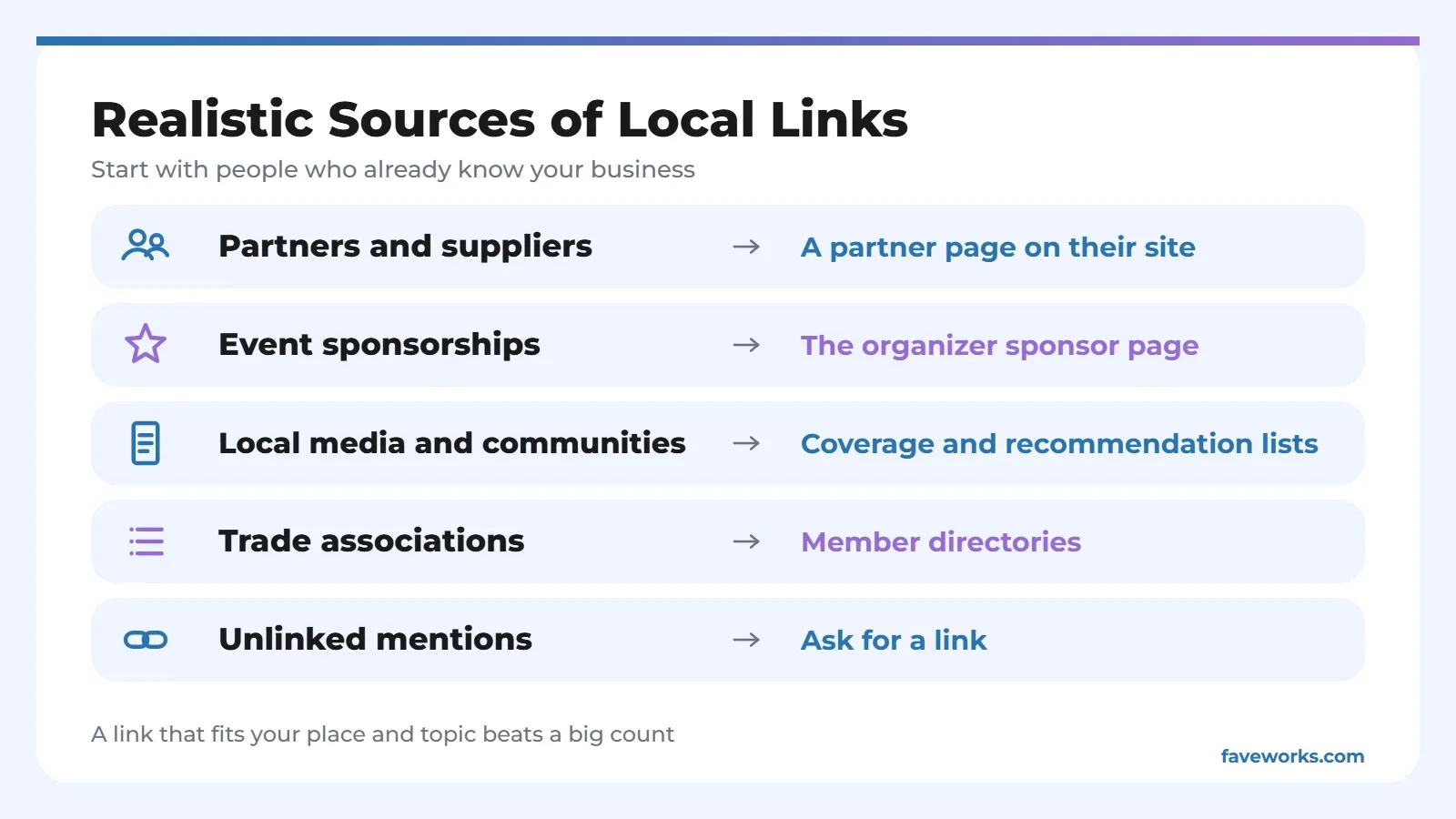
Partners and suppliers
Suppliers, distributors, and regular clients often have a partner page or customer list. Ask for your business name to be listed with a link to your website. For B2B companies, this is often the most relevant source and the easiest one to get.
Sponsorships and community events
Say a print shop in Surabaya sponsors a neighborhood futsal tournament. The organizer lists its name and link on the sponsor page. That is one link, but from a site tied to the same area and activity, and its value is larger than it looks.
If the sponsorship is paid, ask the organizer to add a rel sponsored or nofollow attribute to the link. Google treats that as the correct way to mark paid links.
Local media and communities
A press release about a new branch, a new program, or a partnership can go to regional media and community blogs. Write it from an angle useful to their readers, not as raw promotion. One article that mentions you is worth more than ten you wrote yourself.
Unlinked mentions
Watch for your business name. When a site mentions it without a link, send a short, polite message asking them to link to the right page. Not everyone replies. Some are glad to be corrected.
Local Content Worth Linking To
People link to what helps them. For a micro business, that might be a list only you hold: average service prices in your city, a market schedule, or a map of raw-material suppliers nearby.
For B2B, customer case studies and short data from your work tend to attract links more easily than general articles. Satisfied customers are often willing to link to a story they appear in.
Google Rules You Should Know
Google defines link spam as links made mainly to manipulate rankings. The list of examples is long.
| Practice | Status under Google policy | Notes |
|---|---|---|
| Buying or selling links for ranking | Link spam | Includes trading money, goods, or services for links |
| Excessive link exchanges | Link spam | Partner pages created only to link to each other |
| Automated link creation | Link spam | Programs or services that spread links |
| Guest posts or press releases with keyword-rich anchors | Link spam | When done at scale |
| Low-quality directories or bookmarks | Link spam | Includes widgets or footers with hidden links |
| Ads or sponsors marked rel sponsored or nofollow | Allowed | Google calls this normal when the attribute is set |
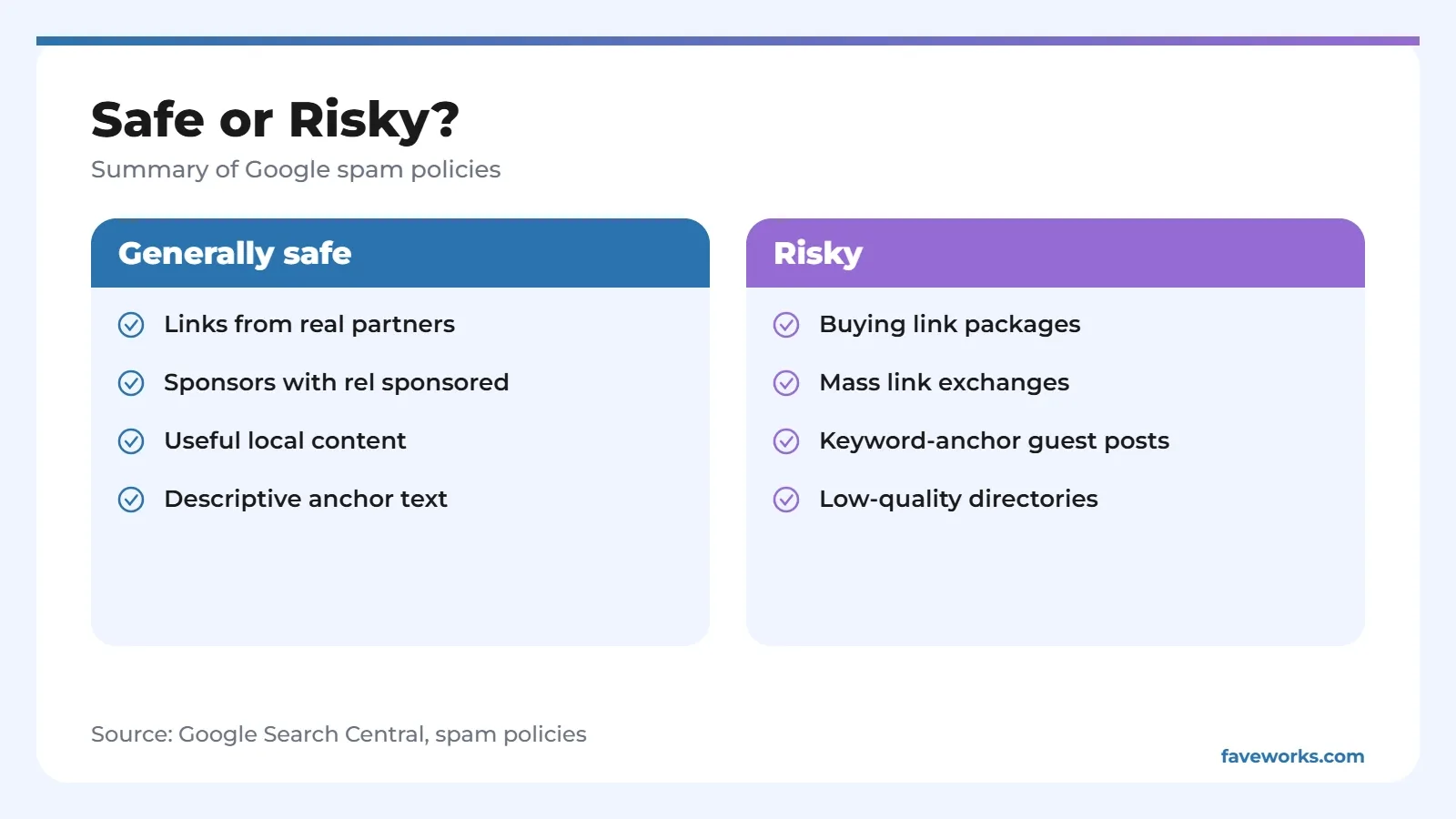
On anchor text, Google asks for text that is descriptive, concise, and relevant to the target page, not "click here" and not a string of keywords. The nofollow attribute also does not belong on every outbound link. Google suggests using it only when you do not trust the source.
How to Judge a Link Source
In local link building, ask three things before chasing a link: is the site real and does it have readers, does its topic or location relate to yours, and is the link given because you deserve a mention. If any answer is no, skip it.
This is a working judgment, not an official Google list. It is a simple rule for a small team that cannot check each domain at length.
Priorities for Micro Businesses and B2B
For local link building at a micro business, start with partners, community groups, and one local article. Also tidy your business profile and your citations first, since both go faster, and see our post on local SEO tools for help with that work.
For B2B, go after trade associations, suppliers, and clients willing to link to a case study. If you want a link strategy drafted together with a technical audit, our SEO services team can help build the list.
FAQ
Is local link building still needed in 2026?
Yes, but not as the first priority. The 2026 Whitespark survey ranks the quality of links to the profile page 25th among map factors, below profile, distance, and reviews.
Can I buy local links?
You can for ads or sponsorships, as long as the link carries rel sponsored or nofollow. Buying links to lift rankings without that attribute counts as link spam under Google policy.
Do links from Google Business Profile count?
Google help pages on local ranking do not explain this. Do not make it your only source, and focus on sites outside Google's own platforms.
How many links does a small business need?
There is no official number. Start with a few relevant links from partners and communities, then add more as you can keep the quality up.
What if bad links point to my website?
Do not panic, but note the pattern first: which domains, which anchors, since when. If you ever bought links, stop and ask site owners to remove them. If they appeared without your involvement, a small number usually does not need handling one by one.