Are Featured Snippets Still Worth Chasing in the AI Overview Era?
A featured snippet is the answer box above Google's organic results. It pulls a passage from one page and links back to it. You can't apply for one. Google decides, so your job is smaller than it sounds: write an answer that's easy to lift, and keep the page in the top ten.
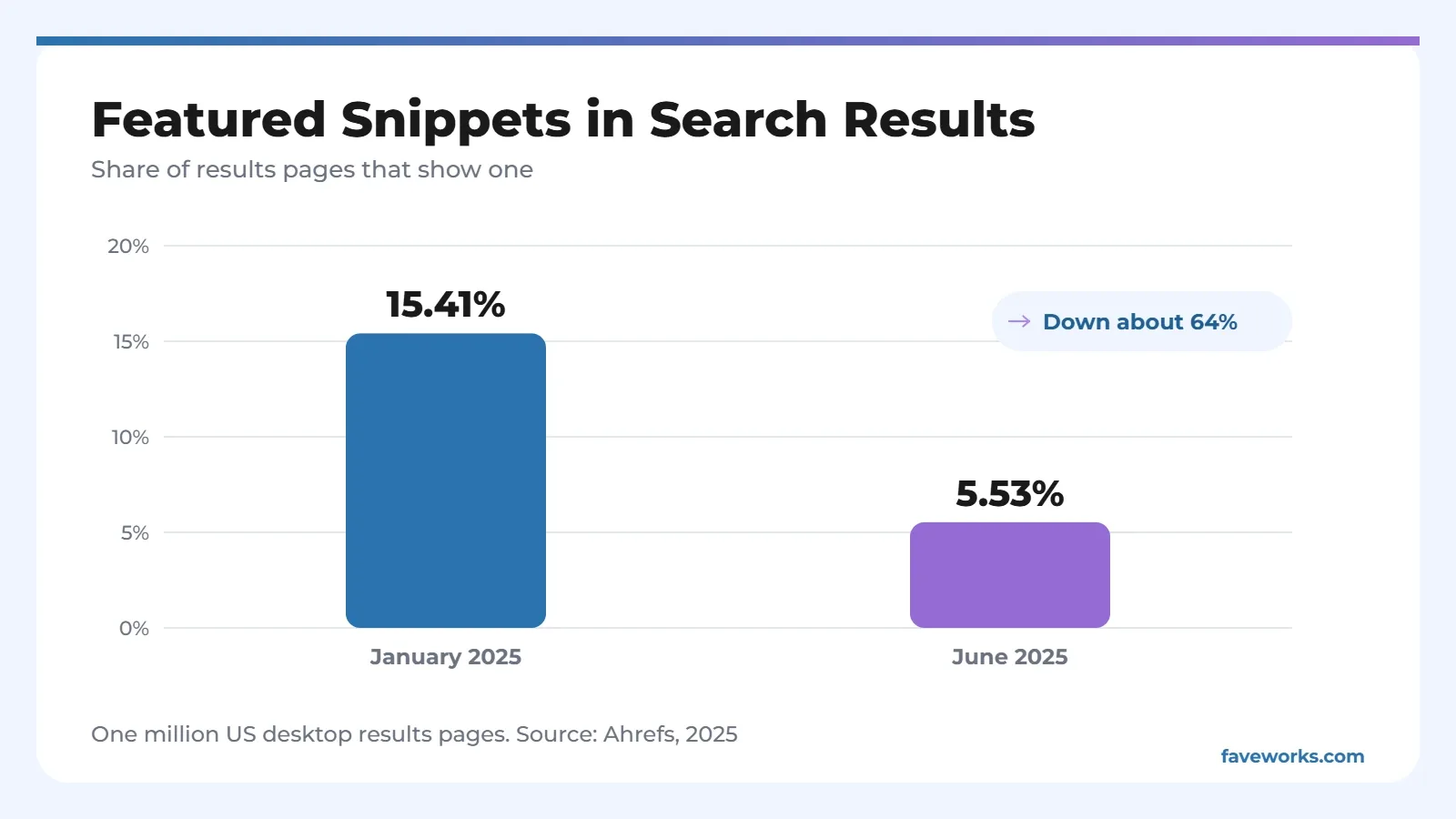
The prize has shrunk. Ahrefs found featured snippets on 15.41% of results pages in January 2025 and on 5.53% by June 2025. That sample was one million desktop results pages in the US, so numbers for other countries or languages may differ. The direction is still hard to ignore.
What a Featured Snippet Is, and Why People Call It Position Zero
A featured snippet flips the usual layout. The answer shows first, and the page title and URL come after. SEOs call it position zero because the box sits above the first organic result.
Google's documentation adds a detail most guides skip. On supported browsers, clicking the snippet scrolls you straight to the passage it quoted. When Google can't tell which part it used, you land at the top of the page.
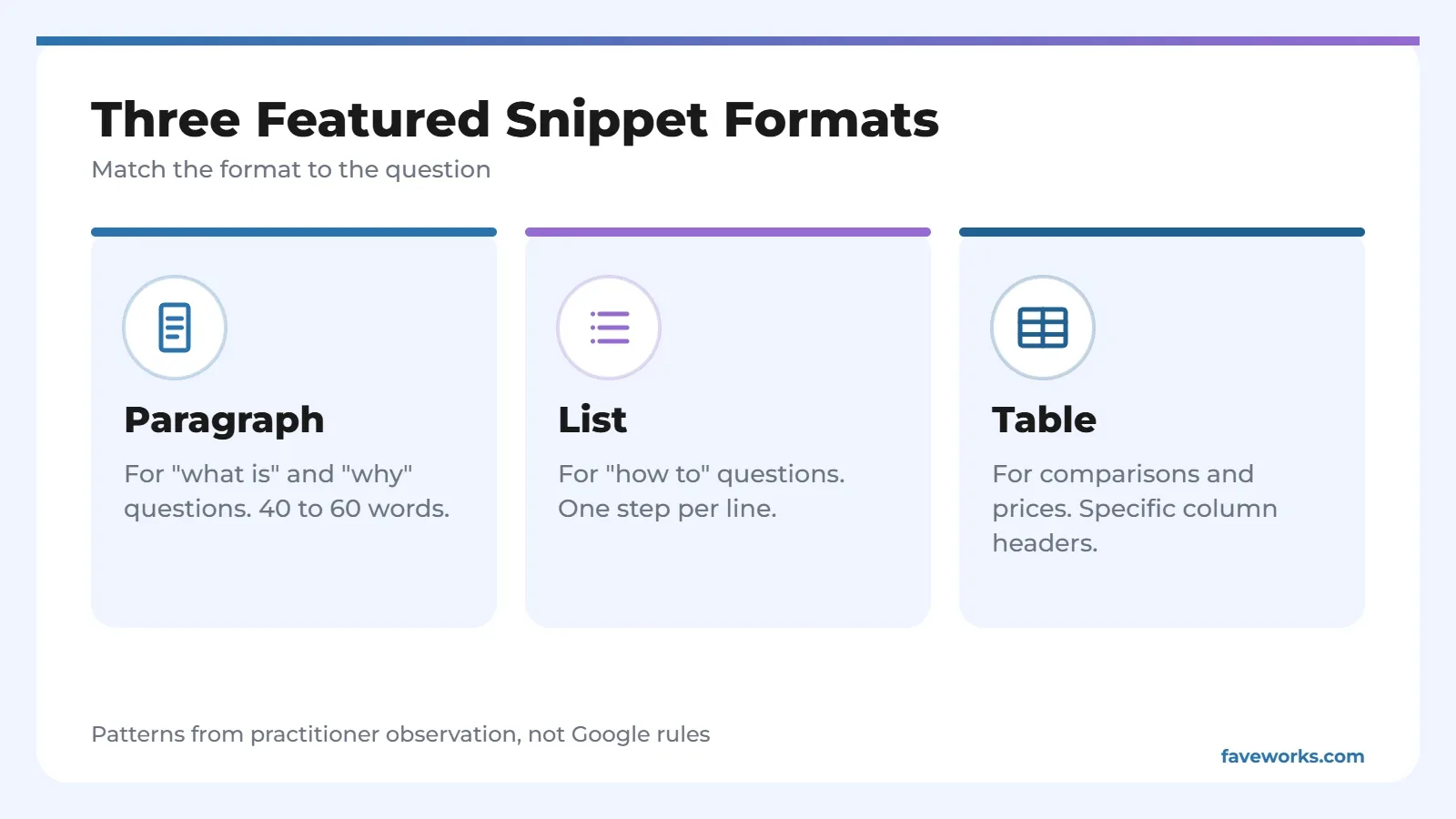
Google doesn't publish a breakdown of formats. The table below comes from what practitioners keep seeing, so read it as a pattern, not a rule.
| Format | Typical question | How to write it |
|---|---|---|
| Paragraph | "What is...", "Why does..." | A 40 to 60 word answer right under the heading, no warm-up sentence |
| List | "How to...", "Steps to...", "Tips for..." | One step per line, each opening with a verb, order obvious without reading anything else |
| Table | "Difference between...", "Price of...", "X vs Y" | Specific column headers, at least three rows, short cells |
How Big Is the Opportunity Now?
Smaller, but not gone. One condition applies: the page has to rank in the top ten for that query already.
Ahrefs studied roughly 112 million keywords and found that 12.29% had a featured snippet. Of those snippets, 99.58% came from pages already in the top ten. The study first ran in 2017 and the page was updated in December 2025, so it's an older picture. It still teaches one lesson that hasn't aged: without a top ten ranking, your odds are close to zero.
Clicks are messier. Ahrefs tested 100,000 keywords with at least 100 searches a month. A number-one result with no snippet drew about 26% of clicks. When a snippet was present, the page it quoted got about 8.6%, and the page right below it got about 19.6%.
Say a query gets 10,000 searches a month. At 26%, an unboxed number-one result collects around 2,600 clicks. Quoted in the box at 8.6%, the same page collects about 860, while the result beneath it at 19.6% gets roughly 1,960. Winning the box can cost you traffic. Annoying? A little.
There's also a newer factor. Ahrefs recorded AI Overviews on 27.43% of results pages in its sample, more often for informational queries, and its authors suspect the feature is pushing featured snippets out.
What You Need Before You Chase One
Top ten first. Format second. That order doesn't flip.
No code, tag, or Search Console setting marks a page as a candidate. Google's documentation says site owners can't do that, and it doesn't list requirements for being chosen. Everything in the next section is practitioner observation, with no guarantees attached.
Writing an Answer That's Easy to Lift
Put the direct answer under a heading that contains the question, then explain. Google needs a passage that stands alone.
Answer first, explain after
Write one paragraph of 40 to 60 words that makes sense without the rest of the page. Plenty of practitioners use that range, but it's an industry habit, not a Google rule. Put the core of the answer in the first sentence.
Turn steps into a numbered list
For "how to" questions, write the steps as a numbered list, one line each, and open each line with a verb. Long paragraphs inside a single step defeat the point.
Use question-style headings, when they fit
A heading like "What is schema markup?" matches how people type into the search box. If it sounds forced, skip it. Write a plain heading and open the section with a sentence that answers it.
Keep the page structure clean
Use headings in order and real tables, not screenshots of tables. An answer locked inside an image can't be quoted. Structured data such as schema markup helps Google understand a page, but Google's snippet documentation doesn't list it as a requirement.
Checking Your Result
Search your target keyword in an incognito window and see whether your domain owns the box. Check on a phone too, because Google's documentation says snippet length differs across mobile, app, and desktop.
Write down the date you checked. The box can move to another page without warning. In Search Console, compare clicks and CTR for the target query before and after you tidy the page, so you know whether the change helped or quietly cost you clicks.
How to Remove a Page From Featured Snippets
Use the nosnippet rule if every snippet should disappear. Use max-snippet with a small value if you only want the featured snippet trimmed, though only nosnippet is certain to work.
Google's documentation warns that a low max-snippet value may not stop the box, and it names no minimum. The data-nosnippet attribute hides specific text from regular snippets and featured snippets alike. If you set both nosnippet and data-nosnippet, nosnippet wins.
When a Featured Snippet Deserves Priority
Chase it for questions with short answers where the searcher still has to click to decide, like price comparisons or technical steps. For simple definitions the box often answers everything, so clicks stay small.
One thing rarely gets mentioned. A page with a tidy answer block probably stays useful to AI-generated summaries even when the box never appears, so the work isn't wasted. If you'd like to know which of your pages sit closest to a snippet, our SEO services team can check with you.
FAQ
Is a featured snippet the same as position zero?
In everyday use, yes. Position zero is what SEOs call the answer box above the first organic result, while Google's documentation says featured snippet.
Can I ask Google to show my page as a featured snippet?
No. Google's documentation says site owners can't mark a page for it. Google's systems decide which page deserves the spot.
Do I need to rank number one first?
Not number one, but the top ten. In the Ahrefs study, 99.58% of snippets came from top ten pages, and only 30.9% came from the very top position.
Does schema markup guarantee a featured snippet?
There's no basis for that. Google's featured snippet documentation doesn't mention schema markup as a requirement. Add it for other reasons, like helping Google understand the page type.
How long until a page can win one?
There's no official number. Google decides each time someone searches, and the box can change hands at any moment. Check your target keywords regularly and refresh the answer when new data appears.